


Article Written By Christopher Moine, SFFN Senior Editor
AI was not used to write this article. Unless you count spell check…
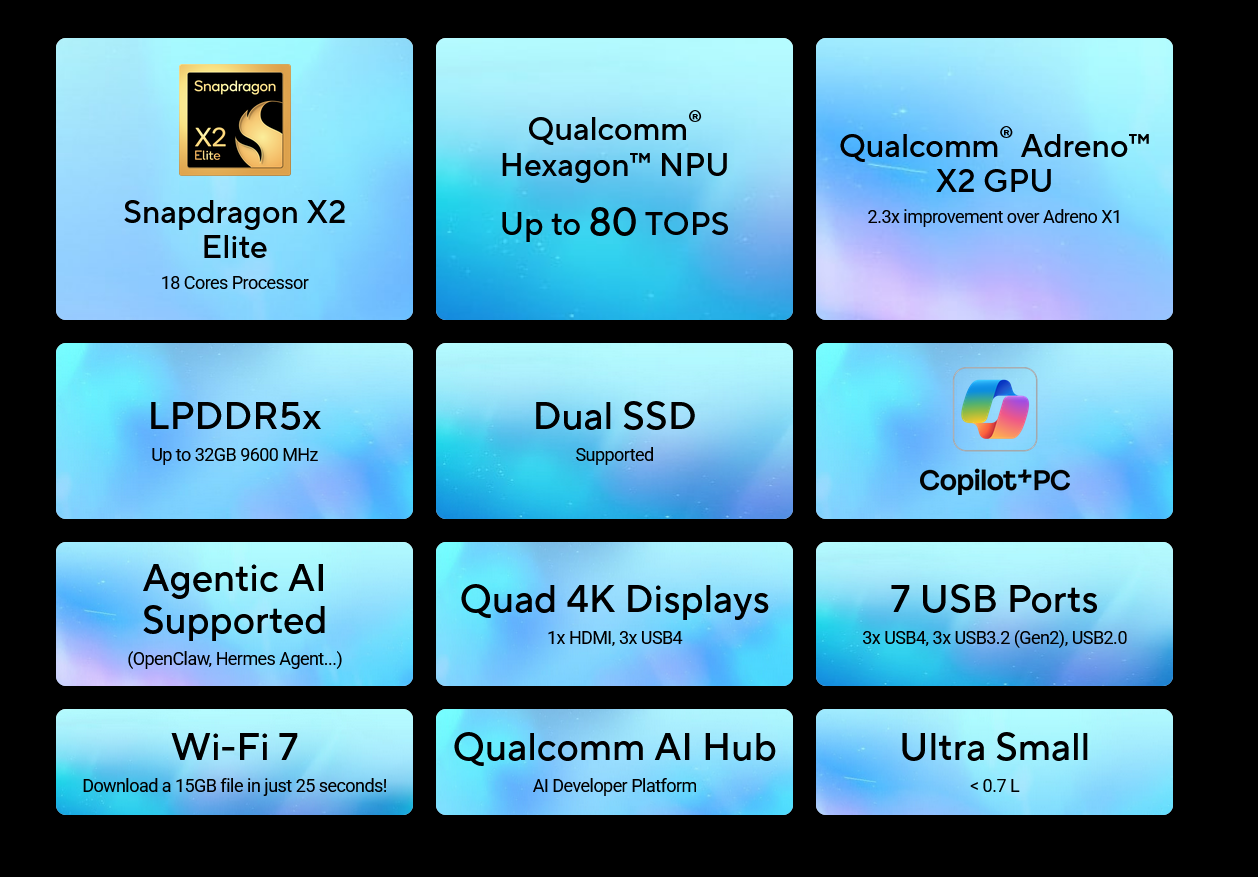
Qualcomm’s Snapdragon X2 Elite processor is finally making some headway into the desktop market in the form of a 0.7L volume mini-PC by Asus. Called the Asus Ascent QN10, the mini-PC is, of course, being primarily advertised for its AI capabilities with up to 80 TOPS of NPU performance, as well as power efficiency, and quiet operation. If that doesn’t interest you, Asus would also suggest it be used for digital signage with up to quad 4K monitors, and creator workloads.
This is not the first time the Snapdragon X2 Elite ARM RISC based processor has found it’s way into the traditional X86-Windows world. Laptops such as the $1,699 Asus-Zenbook A16 feature Snapdragon processors. ETA Prime tested the Snapdragon X2 Elite X2-8100 processor, which is the model below the highest end CPU model, and found it to be capable of running older games such as Shadow of Tomb Raider at 1080P at an average of 44FPS, GTA V Enhanced Edition, at 1080P High, at roughly 90 FPS, and Cyberpunk 2077, at 1080P High, with FSR 3 (unknown setting) at roughly 40 FPS. 3DMARK Timespy scored 4,084 with a GPU sub-scoreyout of 3,660 and CPU sub-score of 11,894.
Power usage was between 28 and 35 watts.
You can check out his video below.
While not exactly a gaming powerhouse, especially in comparison to the new Intel ARC B390 iGPU, it does represent an important step forward for Windows for ARM advancement, and is more focused on the office, kiosk, and AI studio environments. That said, Asus was quick to point out that the Snapdragon X2 Elite had the Adreno X2 GPU, and provided a 2.3X improvement in performance over the X1.
What is the Snapdragon X2 Elite?
Introduced in 2025, the Snapdragon X2 Elite comes in several variants with Asus advertising 18 Cores. This likely makes it the X2E-88-100 model, which is the same model that ETA Prime tested in the above video. The Adreno X2-90 GPU in the X2E-88-100 is rated for up to 6.9 TFLOPS at 1,700 MHz, and the CPU features the Oryon ARM RISC core at up to 4.7 GHz on in single and dual core workloads. Memory is a unified pool of LPDDR5X-9523, providing up to 152 Gigabytes per second bandwidth.
For those that want to know more about ARM RISC vs X86, Gary Explains has put out a great video to give you the gist of it.
Returning back to the Asus Ascent QN10, you can check out Asus’ product page by clicking HERE.
Like most products introduced at Computex this year, pricing wasn’t available at the time of writing this article.


