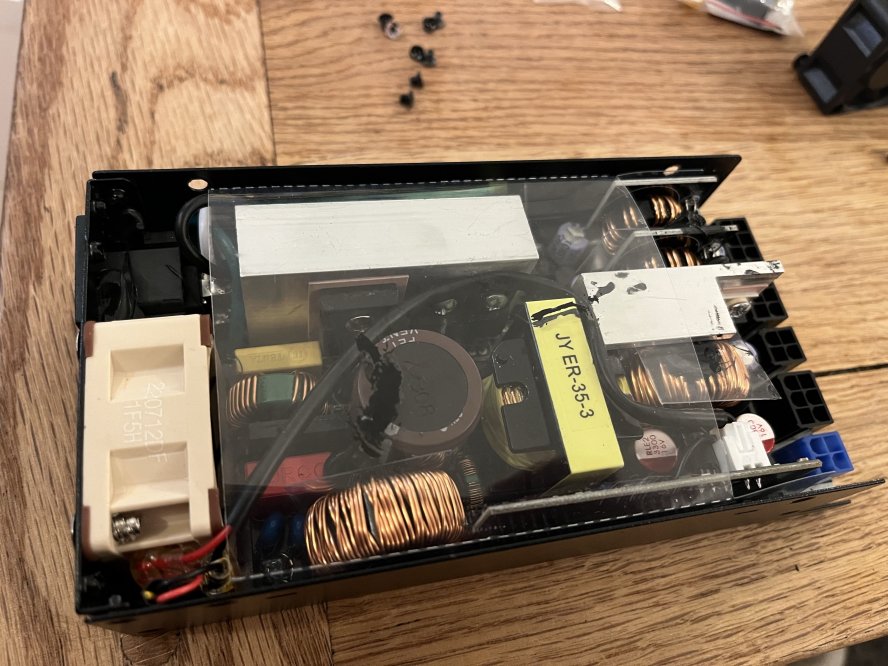
Advice Replacing FlexATX fan for Noctua NF-A4x10 - potential static pressure issues?

blownwiththewind

Minimal Tinkerer
Original poster
New User
Jun 16, 2025
4
1
Hi, everyone! So i've spent a day to collect all possible information about FlexATX fan upgrades and found no follow-ups. People generally replace stock 40mm fans with Noctua NF-A4x10 which is usually twice slower, has around 70% less static pressure and around 30-40% less airflow. It is surely quieter however I found no feedback on how PSU reacts on such upgrade in terms of temps.

I have a FlexATX 500W in my mini PC, and under full load it's around 270-290W. So in theory a stock fan at 10 000 rpm with higher static pressure should do the job. But it's too noisy. So the only viable option i found is Noctua NF-A4x10 fan. How can I make sure my PSU won't be damaged after this upgrade? I heard different opinions: some say PSU will die pretty quickly, some say that any fan will basically do the work since the airflow is too low anyways to completely cool down PSU under heavy load, and that just a stable somewhat airflow will do the same job. And like i said, nobody actually tested it.

Any advice on this? I don't want to make such upgrade and hear my PSU explode one day. There's not much information on web, luckily I found this forum which should be the right place to ask for an advice.
 

SFFMunkee

Buy first, justify later?
Gold Supporter
Jul 7, 2021
1,148
1,254
1750163448645.jpeg
I put a Noctua 4020 in my FlexATX “FSP 600W” (which I’m fairly sure is actually a Metalfish product) and it’s been happily running a Ryzen 5600G/RTX4060 for a couple of years and now 8600G/RTX4060 :)
 

blownwiththewind

Minimal Tinkerer
Original poster
New User
Jun 16, 2025
4
1
I know, unfortunately i can only instal 10mm version, 20 mm won't fit my PSU. But i watched characteristics, they don't differ much. But thanks for a feedback! At least if it runs for 2 years, I guess mine might have a chance too with 10mm version.
 

blownwiththewind

Minimal Tinkerer
Original poster
New User
Jun 16, 2025
4
1
So, upon testing the upgrade I have something interesting to say.

The main temperature I used for my tests was the spot of the fan exhaust. I used infrared thermometer to measure the temps which are probably the temps of surfaces of some components located right behind the fan. I started with Noctua and found out that after some time during intensive load the temp was 58-59 degrees. While in idle it varies between 46-48. Interesting fact: if i start my PC and do nothing idle temp may be 41-42 but If i play some games then it will unlikely comback to those values and stabilize at around 46-48 after some time.

I measured a typical consumption during average gaming load and it showed 300-310W from the wall. I think my PC can draw up to 325-330W during some stress tests as well. So under those conditions the temperature of the measured PSU spot is around 58-59.

However.... when I replaced tha fan with a stock Delta it showed the same 58-59 degrees in the same spot, although the fan was significantly louder and spinning much much faster. From my personal observation maybe (!) the heat build-up took a bit longer with a stock fan but eventually the temperature of the spot was the same.

Next test was to disassemble PC as quickly as possible after shutdown to measure the temp of PSU surface. It showed around 51-54 degrees in both scenarios, however with stock fan one of two measurements even showed 56. Under the cover there's the main transofmator i guess, so it's temperature was 60 degrees in all measurements. Not sure if it heats up much more during work since it has a thermal pad to the cover and cover should deal with that extra heat generated.

Unfortunately I havent yet done prolonged tests - i think the longest was around 1.5 hours. However, for now for some reason I didn't see any significant difference in temperatures between a stock fan and noctua. However, Noctua is not completely silent. Under full constant load when PSU gains those 58-59 degrees on exhaust, you can actually hear it spinning. The noise however is much lower and with less mechanical artifacts because of a high quality bearing.

I think the main reason people underestimate Noctua performance is that probably Noctua gives static pressure value at highest rated CFM. While Delta gives the static pressure value at 0 CFM. But i looked at Delta performance curve it showed around 2.3mm at around 6 CFM, which is not that much higher than Noctua. Then we deal with a PSU inside a mini PC case where the heat is trapped. So i guess unless you have a big fan which pulls in cool fresh air in that compartment with PSU it will still heat up to 60, as the hottest part of my PC case nearby the PSU is also around 60. Which i'd say pretty normal for metal PC surface, even my laptop gets around 50 degrees under moderate load, and it doesn't consume 300W...

My main disappointement was that the stock fan couldn't keep PSU temps below 50 degrees... While without case PSU showed around 45-46 degrees max with both fans. So i guess the main reason of heating up is a closed compartment (even tho it has a mesh in the bottom). I guess in this scenario there's no fan that could properly cool it down below 50 degrees.

Another interesting fact is that actually the fan curve is pretty tight. I think everything below 50 degrees it doesn't spin up the fan. While at 60 it blows at full speed for Noctua. And probably the control is based on RPM, not PWM. Cause stock fan doesn't rotate at full speed at 60 degrees while noctua seems to have a full rotation speed.

If anyone has suggestions on what further tests i could make and what I could measure please share.
 
  • Like
Reactions: TheJiral