Log Project Avengers: Moving Towards a 48V Ecosystem – Integrating Hynetek Modules with Direct-plug DC-ATX for a "Cable-less" ITX Build

Yqf

Cable Smoosher
Jan 23, 2026
9
6
各位SFF社区的朋友们,大家好!我来自法国。和你们中的许多人一样,过去两个月我一直在计划组装一台高性能的扁平式ITX主机,主板是华硕ROG STRIX B860-I,处理器是英特尔Ultra 7 265。虽然定制的木质面板机箱已经基本成型,但我遇到了SFF主机最大的难题:笨重的24针ATX电源线

现在是 2026 年,埃隆·马斯克正在推动汽车采用 48V 架构以减轻重量和节省空间,而我们的 PC 行业仍然停留在几十年前设计的 24 根电线的捆绑式架构中。

问题:

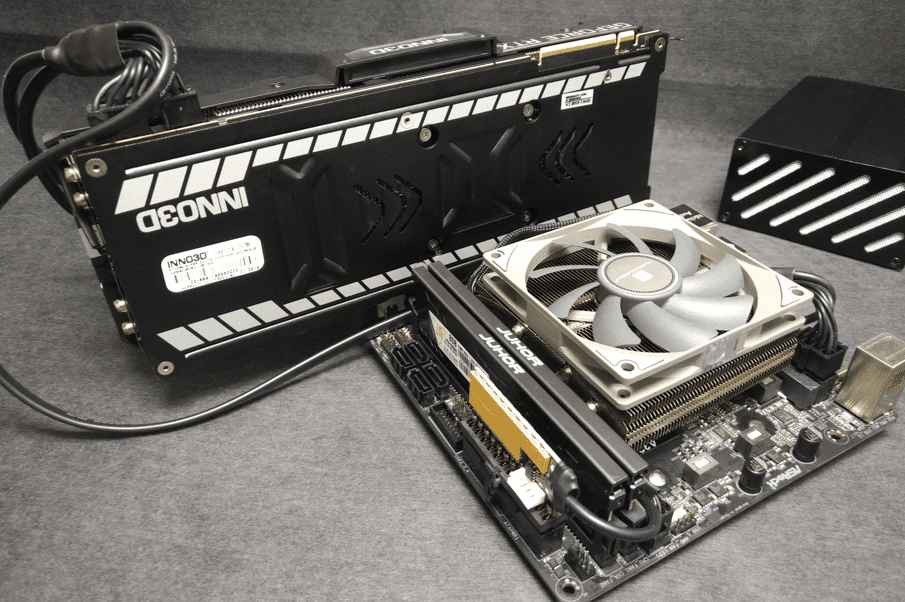
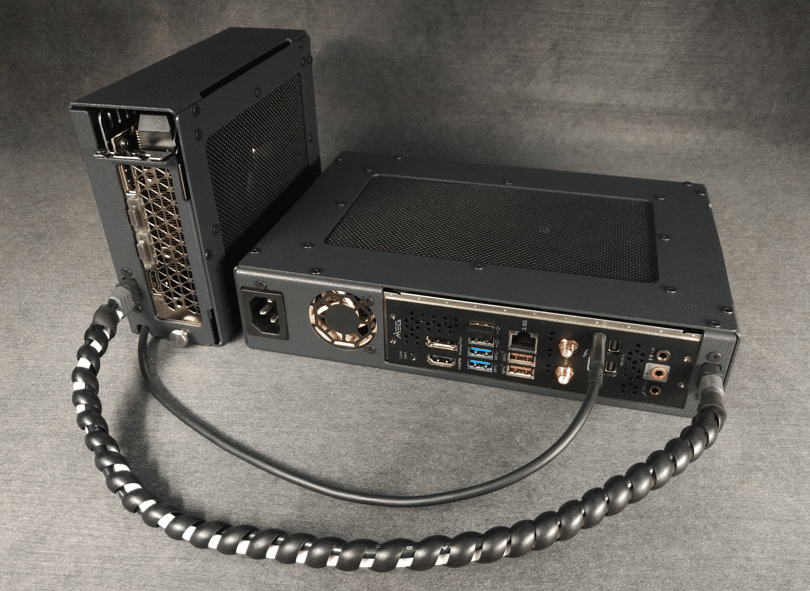
看看我目前的装机方案,内部空间几乎被一堆黑色线缆占据了。这不仅影响美观,还会造成散热隐患,阻碍空气流通,甚至导致顶盖无法完全闭合。在扁平机箱里,根本没有空间隐藏这么多铜线。

愿景:48V DC-ATX 革命

我认为Mini-ITX的未来在于48V生态系统。我的目标是设计一款定制的集成电源板,将高压直流输入与直插式DC-ATX外形尺寸相结合。

拟采用的技术栈:

  • 输入:48V 直流,通过 GaN 电源适配器(借鉴自专业音频或工业领域)。
  • 系统核心Hynetek 48V降压模块。这些芯片效率极高且体积小巧,能够将48V电压降至稳定的12V,且发热量极低。
  • 外形尺寸:直接插入式 DC-ATX 主板(类似于 Pico-PSU),直接安装在 24 针接头上,无需任何内部 24 针电缆。
为什么是 48V?

  1. 更低电流:300W 功率在 19V 电压下需要约 16A 电流,这几乎达到了 7.4mm 连接器的极限。而在 48V 电压下,我们只需要约 6A 电流,从而使系统运行更凉爽、更安全。
  2. 超薄设计:通过将主要转换移至主板上基于 Hynetek 的小型模块,我们可以回收足够的垂直空间,以便使用更高效的散热器或更纤薄的机箱。
  3. 效率:高压输电可显著降低$I^2R$损耗。
现状与挑战:

我已经组装好了核心硬件。目前我正在等一个从德国寄来的19.5V适配器才能启动它,因为法国似乎缺少专业的电子元件。不过,这只是暂时的。

我向社区提出的问题:

  1. 有没有人成功地将Hynetek 48V模块集成到PC供电系统中?
  2. 是否存在支持在单个直插模块中实现48V 转 12V 转 ATX转换的现有 PCB 设计?
  3. 将高频降压转换器放置在靠近 RAM 和 CPU 的位置时,需要考虑哪些 EMC/EMI 问题?
我计划用3D打印技术为我的机箱制作一个垫片来解决暂时的高度问题,但长远目标是定制一块48V集成电路板。我非常乐意与任何对开发这种“特斯拉式”PC电源架构原型感兴趣的人合作!

MOD EDIT:
Hello everyone in the SFF community! I'm from France. Like many of you, I've been planning to build a high-performance flat-panel ITX PC for the past two months, using an ASUS ROG STRIX B860-I motherboard and an Intel Ultra 7 265 processor. While the custom wood-panel case is mostly complete, I've run into the biggest hurdle for SFF PCs: the bulky 24-pin ATX power cable.

It's 2026, and Elon Musk is pushing for 48V architecture in the automotive industry to reduce weight and save space, while our PC industry is still stuck in the decades-old design of bundled 24-pin power cables.

The Problem:

Look at my current build; the internal space is almost entirely filled with a bunch of black cables. This not only affects aesthetics but also creates heat dissipation problems, obstructs airflow, and even prevents the top cover from closing completely. There's simply no space to hide so many copper wires in a flat-panel case.

Vision: The 48V DC-ATX Revolution

I believe the future of Mini-ITX lies in the 48V ecosystem. My goal is to design a custom integrated power board that combines high-voltage DC input with a through-hole DC-ATX form factor.

Proposed Technology Stack:

Input: 48V DC via a GaN power adapter (borrowed from professional audio or industrial applications).

System Core: Hynetek 48V buck modules. These chips are highly efficient and compact, capable of stepping 48V down to a stable 12V with minimal heat generation.

Form Factor: Through-hole DC-ATX motherboard (similar to a Pico-PSU), mounted directly on a 24-pin connector without any internal 24-pin cables.

Why 48V?

Lower Current: 300W of power requires approximately 16A at 19V, which is almost at the limit of a 7.4mm connector. At 48V, we only need about 6A, resulting in a cooler and safer system operation.

Ultra-thin design: By moving the main conversion to a small Hynetek-based module on the motherboard, we can reclaim enough vertical space for a more efficient heatsink or a slimmer chassis.

Efficiency: High-voltage transmission significantly reduces I^2R losses.

Current situation and challenges:

I have assembled the core hardware. I am currently waiting for a 19.5V adapter to arrive from Germany to get it running, as there seems to be a shortage of specialized electronics in France. However, this is only temporary.

Questions for the community:

Has anyone successfully integrated a Hynetek 48V module into a PC power supply system?

Are there existing PCB designs that support 48V to 12V to ATX conversion in a single through-hole module?

What EMC/EMI issues need to be considered when placing a high-frequency buck converter close to RAM and CPU?

I plan to use 3D printing to create a spacer for my chassis to address the temporary height issue, but the long-term goal is to customize a 48V integrated circuit board. I would love to collaborate with anyone interested in developing a prototype of this “Tesla-style” PC power supply architecture!
 
Last edited by a moderator:

Yqf

Cable Smoosher
Jan 23, 2026
9
6
@Yqf Please post in English, as per the rules you agreed to when registering.
Hi, thank you so much for the heads-up and for helping me translate the post!

I am really sorry for the inconvenience. It was completely accidental—I actually pasted the content in English, but my browser's auto-translate feature unexpectedly translated the text inside the editor box into Chinese right as I was about to click 'post.' I didn't catch it in time before it was sent.

I’ll make sure to double-check and disable auto-translate for this site to ensure it stays in English next time. Thanks again for your patience and for the help!
 

46x02

Chassis Packer
Sep 1, 2025
16
10
A Tesla car has a very prominent item that requires rather high voltage - around 300 volts. Can you guess what this item is? It is of course the motor.

A typical computer has no component that requires over 12 volts.

If you have the (mis)fortune of having a voltage supply of 48V, companies such as Pico Box already have power supply products on the market that can take this as input.

In the case of a data center, one deals with an immense amount of cabling and 48V does offer a meaningful advantage in terms of efficiency there.

By the way, I asked a language model to look for flaws in your post, and here is a brief summary: (bold text is provided by AI, remainder is my own writing)
The "Revolutionary" Form Factor (False Assertion) - Pico PSUs for reasonable input voltages already exist.
Efficiency and I²R Losses (False Assertion) - The cable lengths inside a desktop computer do not suffer meaningful losses at 12V.
[Redacted] Modules and Power Density (False Assertion) - Overall power density is worsened by introducing 48V. I'm not quite sure where your enthusiasm for a specific company's IC comes from. But when developing a new product, it is useful to research existing solutions. It would be prudent to show familiarity with G-Unique's product offerings.
The "Tesla-Style" Analogy (Logical Hole) - An electric car has significantly more internal cabling than a computer, and has a key component (the motor) which requires high DC voltage.
The Power Budget (Logical Hole) - A small form factor system simply does not have enough cooling capacity for high power budgets. You mention "16A at 19V [...] is almost at the limit of a 7.4mm connector" - but no one is limiting us to such a connector. Your own build makes no mention of a dedicated GPU. I however am using an even smaller DC5525 connector in my build with 19V@15A (G-Unique Pico module, Intel 265K, RTX4060) without issue. If frequently disconnected, the connector might degrade, and so too the resistance properties, which could ultimately lead to failure. I guess it's good to be aware of such things.
The 19.5V Adapter Contradiction (Logical Hole) - You are claimining advantages for *48V*, not 19.5V. So why order a 19.5V adapter? There are thin Mini-ITX boards which could be powered directly with such a voltage, but you have made no mention of them thus far, nor are you proposing motherboards themselves be redesigned to take 48V input directly (which would just add unecessary complexity to power circuitry)
EMC/EMI and Component Placement (Logical Hole) - existing Pico modules would face the same theoretical issue, yet they simply work. Nevertheless, the spec sheet for your IC should clearly outline EMI considerations.

Bonus: Look up quarter brick DC-DC modules. Not the smallest product, but there are plenty of existing surface mount solutions on the market which can step 48V down to 12V.

Bonus 2: It strongly seems as if you are talking about an IC intended for USB-PD. I suggest you familiarize yourself with the USB-PD spec. You may realize that USB-PD only allows for up to 3A of current at 12V -- at some stage, you are going to need to step down to 12V to actually power the computer, and 3A is going to prove rather insufficient. And unlike with connectors, you won't find much practical leniency beyond claimed specs.

Finally, a personal question. Is your predilection for em dashes accidental?
 

REVOCCASES

Shrink Ray Wielder
Silver Supporter
Apr 2, 2020
2,256
3,694
Germany / HK
www.revoccases.com
各位SFF社区的朋友们,大家好!我来自法国。和你们中的许多人一样,过去两个月我一直在计划组装一台高性能的扁平式ITX主机,主板是华硕ROG STRIX B860-I,处理器是英特尔Ultra 7 265。虽然定制的木质面板机箱已经基本成型,但我遇到了SFF主机最大的难题:笨重的24针ATX电源线

现在是 2026 年,埃隆·马斯克正在推动汽车采用 48V 架构以减轻重量和节省空间,而我们的 PC 行业仍然停留在几十年前设计的 24 根电线的捆绑式架构中。

问题:

看看我目前的装机方案,内部空间几乎被一堆黑色线缆占据了。这不仅影响美观,还会造成散热隐患,阻碍空气流通,甚至导致顶盖无法完全闭合。在扁平机箱里,根本没有空间隐藏这么多铜线。

愿景:48V DC-ATX 革命

我认为Mini-ITX的未来在于48V生态系统。我的目标是设计一款定制的集成电源板,将高压直流输入与直插式DC-ATX外形尺寸相结合。

拟采用的技术栈:

  • 输入:48V 直流,通过 GaN 电源适配器(借鉴自专业音频或工业领域)。
  • 系统核心Hynetek 48V降压模块。这些芯片效率极高且体积小巧,能够将48V电压降至稳定的12V,且发热量极低。
  • 外形尺寸:直接插入式 DC-ATX 主板(类似于 Pico-PSU),直接安装在 24 针接头上,无需任何内部 24 针电缆。
为什么是 48V?

  1. 更低电流:300W 功率在 19V 电压下需要约 16A 电流,这几乎达到了 7.4mm 连接器的极限。而在 48V 电压下,我们只需要约 6A 电流,从而使系统运行更凉爽、更安全。
  2. 超薄设计:通过将主要转换移至主板上基于 Hynetek 的小型模块,我们可以回收足够的垂直空间,以便使用更高效的散热器或更纤薄的机箱。
  3. 效率:高压输电可显著降低$I^2R$损耗。
现状与挑战:

我已经组装好了核心硬件。目前我正在等一个从德国寄来的19.5V适配器才能启动它,因为法国似乎缺少专业的电子元件。不过,这只是暂时的。

我向社区提出的问题:

  1. 有没有人成功地将Hynetek 48V模块集成到PC供电系统中?
  2. 是否存在支持在单个直插模块中实现48V 转 12V 转 ATX转换的现有 PCB 设计?
  3. 将高频降压转换器放置在靠近 RAM 和 CPU 的位置时,需要考虑哪些 EMC/EMI 问题?
我计划用3D打印技术为我的机箱制作一个垫片来解决暂时的高度问题,但长远目标是定制一块48V集成电路板。我非常乐意与任何对开发这种“特斯拉式”PC电源架构原型感兴趣的人合作!

MOD EDIT:
Hello everyone in the SFF community! I'm from France. Like many of you, I've been planning to build a high-performance flat-panel ITX PC for the past two months, using an ASUS ROG STRIX B860-I motherboard and an Intel Ultra 7 265 processor. While the custom wood-panel case is mostly complete, I've run into the biggest hurdle for SFF PCs: the bulky 24-pin ATX power cable.

It's 2026, and Elon Musk is pushing for 48V architecture in the automotive industry to reduce weight and save space, while our PC industry is still stuck in the decades-old design of bundled 24-pin power cables.

The Problem:

Look at my current build; the internal space is almost entirely filled with a bunch of black cables. This not only affects aesthetics but also creates heat dissipation problems, obstructs airflow, and even prevents the top cover from closing completely. There's simply no space to hide so many copper wires in a flat-panel case.

Vision: The 48V DC-ATX Revolution

I believe the future of Mini-ITX lies in the 48V ecosystem. My goal is to design a custom integrated power board that combines high-voltage DC input with a through-hole DC-ATX form factor.

Proposed Technology Stack:

Input: 48V DC via a GaN power adapter (borrowed from professional audio or industrial applications).

System Core: Hynetek 48V buck modules. These chips are highly efficient and compact, capable of stepping 48V down to a stable 12V with minimal heat generation.

Form Factor: Through-hole DC-ATX motherboard (similar to a Pico-PSU), mounted directly on a 24-pin connector without any internal 24-pin cables.

Why 48V?

Lower Current: 300W of power requires approximately 16A at 19V, which is almost at the limit of a 7.4mm connector. At 48V, we only need about 6A, resulting in a cooler and safer system operation.

Ultra-thin design: By moving the main conversion to a small Hynetek-based module on the motherboard, we can reclaim enough vertical space for a more efficient heatsink or a slimmer chassis.

Efficiency: High-voltage transmission significantly reduces I^2R losses.

Current situation and challenges:

I have assembled the core hardware. I am currently waiting for a 19.5V adapter to arrive from Germany to get it running, as there seems to be a shortage of specialized electronics in France. However, this is only temporary.

Questions for the community:

Has anyone successfully integrated a Hynetek 48V module into a PC power supply system?

Are there existing PCB designs that support 48V to 12V to ATX conversion in a single through-hole module?

What EMC/EMI issues need to be considered when placing a high-frequency buck converter close to RAM and CPU?

I plan to use 3D printing to create a spacer for my chassis to address the temporary height issue, but the long-term goal is to customize a 48V integrated circuit board. I would love to collaborate with anyone interested in developing a prototype of this “Tesla-style” PC power supply architecture!

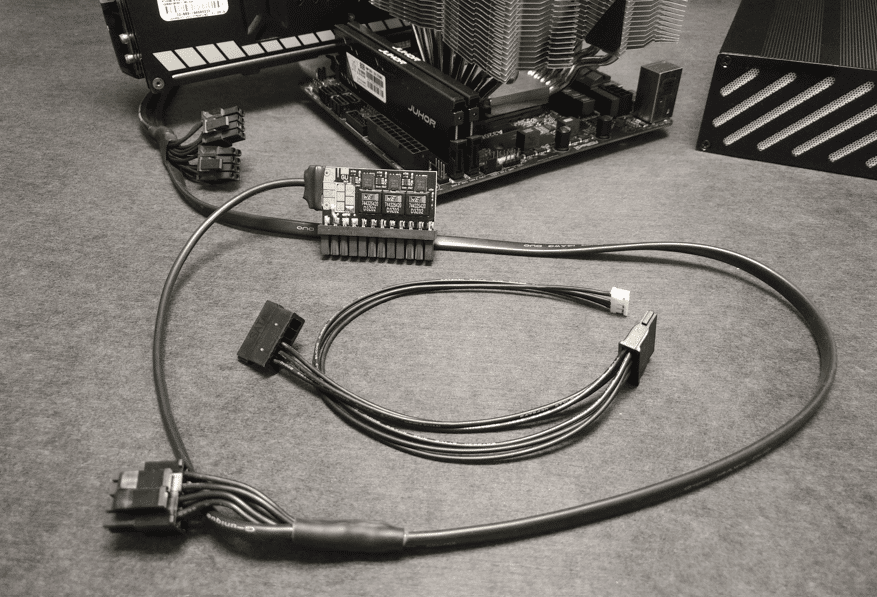
Well, reducing the power cable mess is not really a new idea. G-Unique and me already did a "one cable" 600W solution back in 2020 ...

1769307529356.png

1769307582656.png

It was based on 12V DC Input, but even if you go for higher input voltage, I don't see how this would further reduce the size of your ITX build.

I like your SFF enthusiasm, but if you want to minimize size and increase efficiency, you need to look beyond common ITX hardware...


Last edited:

Yqf

Cable Smoosher
Jan 23, 2026
9
6
Well, reducing the power cable mess is not really a new idea. G-Unique and me already did a "one cable" 600W solution back in 2020 ...

View attachment 4046

View attachment 4047

It was based on 12V DC Input, but even if you go for higher input voltage, I don't see how this would further reduce the size of your ITX build.

I like your SFF enthusiasm, but if you want to minimize size and increase efficiency, you need to look beyond common ITX hardware...


The DC-ATX power boards you're using are currently the smallest customizable options available. They usually take a 12V input, though there are wide-voltage versions like 12V-24V. But what are you using for the external power brick? Also, if the GPU is still plugged directly into the motherboard, the chassis size won't actually shrink that much.

My vision is to make the PC truly modular. For example, separating the main unit from the bulky graphics card. The PC could run on one DC-ATX board, while the GPU is powered by its own dedicated DC-ATX board. This way, both the PC and the GPU enclosure can be miniaturized to the absolute limit.
 

Yqf

Cable Smoosher
Jan 23, 2026
9
6
A Tesla car has a very prominent item that requires rather high voltage - around 300 volts. Can you guess what this item is? It is of course the motor.

A typical computer has no component that requires over 12 volts.

If you have the (mis)fortune of having a voltage supply of 48V, companies such as Pico Box already have power supply products on the market that can take this as input.

In the case of a data center, one deals with an immense amount of cabling and 48V does offer a meaningful advantage in terms of efficiency there.

By the way, I asked a language model to look for flaws in your post, and here is a brief summary: (bold text is provided by AI, remainder is my own writing)
The "Revolutionary" Form Factor (False Assertion) - Pico PSUs for reasonable input voltages already exist.
Efficiency and I²R Losses (False Assertion) - The cable lengths inside a desktop computer do not suffer meaningful losses at 12V.
[Redacted] Modules and Power Density (False Assertion) - Overall power density is worsened by introducing 48V. I'm not quite sure where your enthusiasm for a specific company's IC comes from. But when developing a new product, it is useful to research existing solutions. It would be prudent to show familiarity with G-Unique's product offerings.
The "Tesla-Style" Analogy (Logical Hole) - An electric car has significantly more internal cabling than a computer, and has a key component (the motor) which requires high DC voltage.
The Power Budget (Logical Hole) - A small form factor system simply does not have enough cooling capacity for high power budgets. You mention "16A at 19V [...] is almost at the limit of a 7.4mm connector" - but no one is limiting us to such a connector. Your own build makes no mention of a dedicated GPU. I however am using an even smaller DC5525 connector in my build with 19V@15A (G-Unique Pico module, Intel 265K, RTX4060) without issue. If frequently disconnected, the connector might degrade, and so too the resistance properties, which could ultimately lead to failure. I guess it's good to be aware of such things.
The 19.5V Adapter Contradiction (Logical Hole) - You are claimining advantages for *48V*, not 19.5V. So why order a 19.5V adapter? There are thin Mini-ITX boards which could be powered directly with such a voltage, but you have made no mention of them thus far, nor are you proposing motherboards themselves be redesigned to take 48V input directly (which would just add unecessary complexity to power circuitry)
EMC/EMI and Component Placement (Logical Hole) - existing Pico modules would face the same theoretical issue, yet they simply work. Nevertheless, the spec sheet for your IC should clearly outline EMI considerations.

Bonus: Look up quarter brick DC-DC modules. Not the smallest product, but there are plenty of existing surface mount solutions on the market which can step 48V down to 12V.

Bonus 2: It strongly seems as if you are talking about an IC intended for USB-PD. I suggest you familiarize yourself with the USB-PD spec. You may realize that USB-PD only allows for up to 3A of current at 12V -- at some stage, you are going to need to step down to 12V to actually power the computer, and 3A is going to prove rather insufficient. And unlike with connectors, you won't find much practical leniency beyond claimed specs.

Finally, a personal question. Is your predilection for em dashes accidental?
I appreciate your detailed and professional critique. It’s through these kinds of deep dives and disagreements that we actually find paths to progress. I’d like to share my logic on why I believe 48V and modularity are the future, addressing your points one by one.

1. On 48V and Transmission Efficiency The core value of 48V isn't about the short distances inside the chassis, but the power transmission from the external adapter to the PC and between independent modules. Just as USB-PD 3.1 (EPR) moved to 28V-48V, the goal is to increase wattage without thickening the cable. 48V allows for ultra-thin, flexible power leads—a "holy grail" for SFF enthusiasts who want to get rid of bulky, stiff power bricks.

2. Power Density and Hynetek Solutions While adding a 48V-to-12V stage might seem redundant in a traditional build, modern silicon proves otherwise. Using high-efficiency buck converters (such as those from Hynetek), these modules can be incredibly small and maintain efficiencies exceeding 97%. "Space efficiency" isn't just about component count; it’s about layout. By using a cracker-sized Hynetek-based module for local conversion, we eliminate chaotic 12V wire looms, creating a cleaner internal environment that actually improves airflow and thermal management.

3. The Engineering Ceiling of Connectors Running 19V at 15A (approx. 300W) on a DC5525 is indeed impressive, but it is operating at the absolute physical limit of the hardware. If we want to support next-gen setups (300W-450W+), 19V would require over 20A, leading to significant heat and long-term reliability issues. 48V reduces the current to a quarter, effectively future-proofing the system for high-performance components without the risk of melting connectors.

4. Modularity and the "Bus" Vision The ultimate goal here is "Bus-centric" Modularity. Instead of just replacing a PSU, 48V acts as a universal power bus. In a modular setup where the host and GPU enclosure are separate, they can be linked by a single, thin interconnect. Eventually, motherboards may natively integrate these step-down circuits. I’m not just looking at how to power a PC today, but how to redefine the form factor for a truly modular tomorrow.
 

REVOCCASES

Shrink Ray Wielder
Silver Supporter
Apr 2, 2020
2,256
3,694
Germany / HK
www.revoccases.com
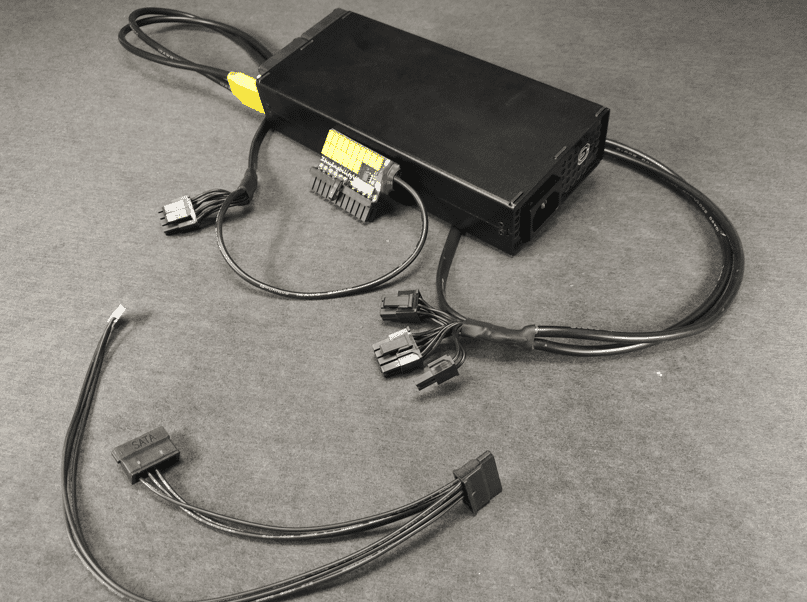
But what are you using for the external power brick? Also, if the GPU is still plugged directly into the motherboard, the chassis size won't actually shrink that much.

You can use an internal or external 12VDC power supply. For example, this one is 12V/800W and not much larger than the high-power 48V GAN power bricks you probably have in mind...

1769390571950.png

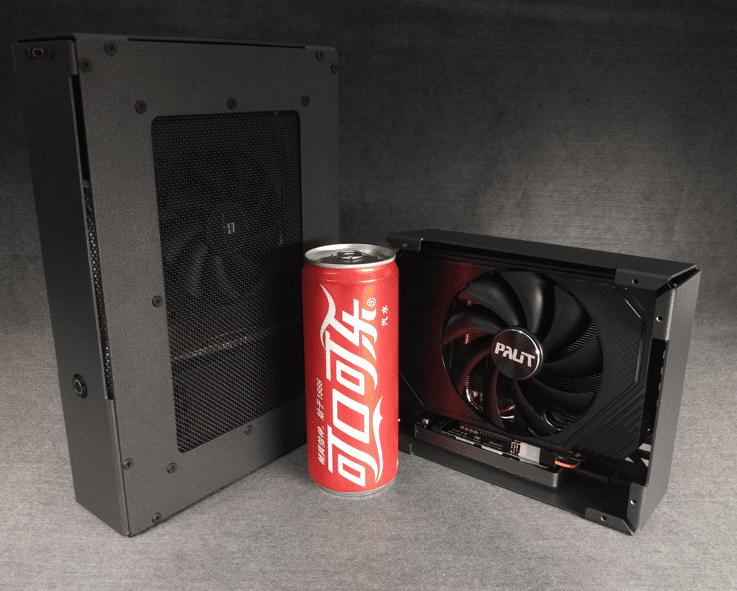
My vision is to make the PC truly modular. For example, separating the main unit from the bulky graphics card. The PC could run on one DC-ATX board, while the GPU is powered by its own dedicated DC-ATX board. This way, both the PC and the GPU enclosure can be miniaturized to the absolute limit.

That just sounds like an eGPU setup, no? Been there, done that... it will add some flexibility, but it won't make your whole setup overall smaller... :p

1769390670730.png

1769390706261.png

1. On 48V and Transmission Efficiency The core value of 48V isn't about the short distances inside the chassis, but the power transmission from the external adapter to the PC and between independent modules. Just as USB-PD 3.1 (EPR) moved to 28V-48V, the goal is to increase wattage without thickening the cable. 48V allows for ultra-thin, flexible power leads—a "holy grail" for SFF enthusiasts who want to get rid of bulky, stiff power bricks.

2. Power Density and Hynetek Solutions While adding a 48V-to-12V stage might seem redundant in a traditional build, modern silicon proves otherwise. Using high-efficiency buck converters (such as those from Hynetek), these modules can be incredibly small and maintain efficiencies exceeding 97%. "Space efficiency" isn't just about component count; it’s about layout. By using a cracker-sized Hynetek-based module for local conversion, we eliminate chaotic 12V wire looms, creating a cleaner internal environment that actually improves airflow and thermal management.

3. The Engineering Ceiling of Connectors Running 19V at 15A (approx. 300W) on a DC5525 is indeed impressive, but it is operating at the absolute physical limit of the hardware. If we want to support next-gen setups (300W-450W+), 19V would require over 20A, leading to significant heat and long-term reliability issues. 48V reduces the current to a quarter, effectively future-proofing the system for high-performance components without the risk of melting connectors.

4. Modularity and the "Bus" Vision The ultimate goal here is "Bus-centric" Modularity. Instead of just replacing a PSU, 48V acts as a universal power bus. In a modular setup where the host and GPU enclosure are separate, they can be linked by a single, thin interconnect. Eventually, motherboards may natively integrate these step-down circuits. I’m not just looking at how to power a PC today, but how to redefine the form factor for a truly modular tomorrow.

While I agree that higher voltages have some advantages, like lower amperage, I still do not understand how this will help making your SFF build smaller. You still need an AC to DC power supply, you still need cables and connectors, you still need converters / DC-ATX board, etc...

A real game changer for SFF would be, if ATX12VO would finally take off and becomes standard.

PS: Which Hynetek Module do you have in mind exactly? Can you provide some detailed draft and data sheets concerning your idea? How is Hynetek better than the power modules from VICOR
 

Yqf

Cable Smoosher
Jan 23, 2026
9
6
You can use an internal or external 12VDC power supply. For example, this one is 12V/800W and not much larger than the high-power 48V GAN power bricks you probably have in mind...

View attachment 4048


That just sounds like an eGPU setup, no? Been there, done that... it will add some flexibility, but it won't make your whole setup overall smaller... :p

View attachment 4049

View attachment 4050


While I agree that higher voltages have some advantages, like lower amperage, I still do not understand how this will help making your SFF build smaller. You still need an AC to DC power supply, you still need cables and connectors, you still need converters / DC-ATX board, etc...

A real game changer for SFF would be, if ATX12VO would finally take off and becomes standard.

PS: Which Hynetek Module do you have in mind exactly? Can you provide some detailed draft and data sheets concerning your idea? How is Hynetek better than the power modules from VICOR
I appreciate the skepticism—it forces us to look closer at the actual engineering trade-offs. Here is why I believe the transition to a 48V-based modular system actually yields a smaller and more efficient build in the long run:

1. The GaN Revolution and Power SharingExternal GaN (Gallium Nitride) adapters are rapidly becoming higher in density and efficiency. By moving the AC-DC conversion outside the chassis, we don't just reduce internal heat and noise; we gain flexibility. As high-power GaN adapters become a universal standard (e.g., via USB-PD 3.1), we move toward an ecosystem where one high-capacity adapter can power multiple devices. When you upgrade your PC, you don't necessarily need to replace the power brick, reducing waste and clutter.

2. Why 48V Shrinks the "Real-World" VolumeWhile the number of components might not decrease, the physical footprint of the interconnects does. High voltage allows for significantly smaller connectors and thinner, more integrated cabling.

  • In SFF builds, the hardest thing to manage isn't the components themselves, but the stiff, bulky wire looms required for high-current 12V delivery.
  • 48V allows us to consolidate power delivery into standardized, high-density links that are far easier to route, effectively reclaiming the "dead space" usually reserved for cable management.
3. On Hynetek, VICOR, and Industry TrendsI wasn't necessarily claiming one brand is "better" than the other; rather, I'm highlighting the technological trend.

  • VICOR is an industry leader in power density, but their solutions are often industrial-grade with costs to match.
  • Hynetek represents the democratization of this technology within the consumer USB-PD/DCDC ecosystem, making high-efficiency 48V conversion commercially viable for DIY and boutique SFF projects.
4. The Evolution Beyond ATX12VOWhile ATX12VO is a positive step toward modernizing PC power, it is ultimately a transition phase. Just as the automotive and data center industries have moved toward 48V to overcome the physical limitations of 12V, the PC industry will eventually follow. ATX12VO fixes the motherboard's internal efficiency, but 48V fixes the entire system’s power delivery bottleneck.

My goal isn't just to build another PC; it's to advocate for a future where high-performance modules are linked by a streamlined, high-voltage bus, making the "messy cage" of wires a thing of the past.